
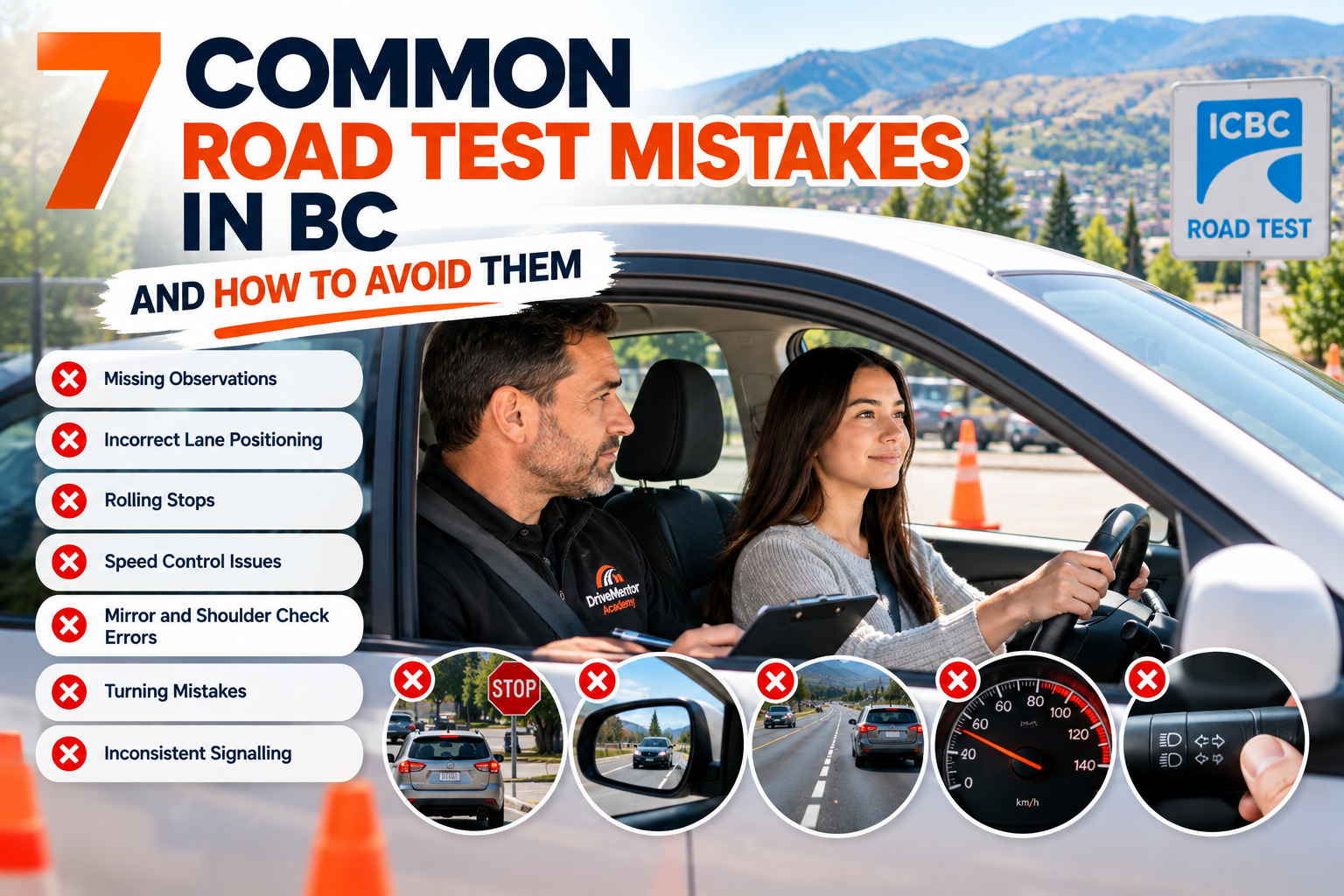
7 Common Road Test Mistakes in BC and How to Avoid Them
Preparing for a road test can make even a capable learner feel nervous. You may know the rules and have practised for many hours, but the test asks you to apply your skills in real traffic while staying calm, observant and in control. Small habits—such as rolling through a stop, forgetting a shoulder check or choosing a speed that does not suit the conditions—can affect safety and your assessment.
If you are searching for common road test mistakes in BC, this guide explains seven areas learners should
practise before their ICBC Class 5 or Class 7 road test. The aim is not to memorize a test route or look for
shortcuts. It is to build consistent driving habits that help you make safe decisions on any road.
Road-test procedures and assessment details can change. Use this article alongside the latest ICBC guidance and feedback from a qualified driving instructor or supervisor.
1 : Rolling Through Stop Signs or Stopping Incorrectly
A stop sign requires a complete stop. Some learners slow down significantly but keep the vehicle moving, while others stop beyond the stop line or in a position that blocks a crosswalk. These habits can create risks for pedestrians and other road users.
Approach the stop sign at a controlled speed and stop at the required position, taking account of the stop line, crosswalk and intersection layout. After stopping, scan carefully and proceed only when you have the right of way and it is safe. If your view is obstructed, move forward cautiously only when appropriate, then check again before entering the intersection. To practise, choose a safe route with different stop-controlled intersections. Focus on a consistent routine: identify the sign early, brake smoothly, stop completely, observe, and move only when safe. Ask your supervisor or instructor to give feedback on both your stopping position and your observation.
1 : Rolling Through Stop Signs or Stopping Incorrectly
Mirrors help you understand what is happening behind and beside your vehicle, but they do not show every blind spot. A learner who changes lanes or moves away from the curb without checking properly may miss a vehicle, cyclist or motorcycle nearby.
Build a deliberate observation sequence for lane changes: check mirrors, signal, shoulder-check the blind spot, confirm the space is clear, and move only when safe. Before turning or pulling over, check the relevant areas around your vehicle and watch for cyclists or pedestrians who may be beside you. Keep scanning rather than treating one check as a guarantee that the space will remain clear
Practise until the sequence becomes a natural habit, but do not perform checks mechanically without understanding what you are looking for. Your attention should remain on the road and traffic situation. A qualified instructor can help you improve the timing and thoroughness of your checks.
3 : Driving Too Fast—or Too Slowly for the Situation
Speed control is not simply about staying below the posted limit. You need to obey speed limits while adapting to traffic, visibility, road surface, weather and the space available to stop safely. Driving too fast for the conditions reduces reaction time. Driving unnecessarily slowly without a safety reason can also disrupt traffic and make your decisions less predictable.
Watch for changing speed zones, including school and playground zones and construction areas. Read signs early and follow the applicable restrictions. When rain, snow, ice, glare or poor visibility affects the road, reduce speed as needed and leave more space ahead.
During practice, ask yourself whether you can stop safely within the distance you can see is clear. Avoid copying drivers who are speeding, and do not rush because you think the examiner expects you to move faster. Aim for a safe, legal speed appropriate to the conditions.
4 : Weak Observation at Intersections and Crosswalks
Intersections bring together vehicles, pedestrians and cyclists moving in different directions. A common error is looking only at the traffic directly ahead, assuming another road user will wait, or entering an intersection before checking that it is safe.
Approach intersections at a controlled speed and scan the relevant directions. Observe traffic signals, signs, lane markings and the movement of other road users. When turning, watch for pedestrians and cyclists crossing the road you are entering. At marked crosswalks, approach carefully and stop or yield as required by the situation and BC road rules.
Do not assume a green light means the intersection is automatically clear. Scan for vehicles that may be finishing a turn or entering late, and proceed only when safe. Practise at different types of intersections so your observations are deliberate rather than rushed
5 : Making Unsafe Lane Changes or Turns
Lane changes and turns require planning. Last-second decisions, incorrect lane positioning, signalling too late or moving into a gap that is too small can put you and others at risk. Some learners also turn too widely, cut corners or drift into the neighbouring lane while completing a turn.
Plan ahead by reading signs and road markings early. Choose the correct lane, signal in good time, check mirrors and blind spots, and make sure the movement is safe before changing position. During turns, control your speed, follow lane markings and remain in the appropriate lane. Never force another driver to brake or swerve to make room for you.
If you miss a turn or lane, do not make a sudden correction. Continue safely and follow the route when anotheropportunity is available. Examiners need to see safe judgement, not perfect navigation.
6 : Poor Parking and Low-Speed Vehicle Control
Parking manoeuvres can be challenging because they require slow, controlled movement and continuous awareness of your surroundings. Common problems include rushing, relying only on mirrors or cameras, failing to check blind spots, approaching at the wrong angle and correcting position without checking for nearby hazards.
Practise parallel parking, reverse or stall parking, backing up and other manoeuvres relevant to your preparation. Move slowly enough to make corrections safely. Look around repeatedly for pedestrians, cyclists, vehicles and obstacles, and use mirrors and shoulder checks as appropriate. Do not depend on parking sensors or cameras alone.
If you need to correct your position, stay calm and make a safe adjustment. The objective is controlled, observant driving—not completing the manoeuvre as quickly as possible. Ask an instructor to identify exactly where your DriveMentor Academy |
7 : Letting Nerves Affect Decisions
Nerves are common before a road test. They may cause learners to rush, forget a routine, overthink a simple instruction or assume that one small mistake means they have failed. Anxiety can also make a driver focus on the examiner rather than the road.
Prepare by practising the full driving routine consistently, not just the manoeuvres you enjoy. Before the test, allow enough time to arrive, bring the required documents and make sure the test vehicle meets ICBC’s requirements. Listen carefully to directions, ask for clarification if you do not understand, and take a moment to observe before acting when it is safe to do so.
If you make a minor mistake, do not dwell on it while driving. Refocus on the next road situation and continue to make safe decisions. You cannot change what has already happened, but you can control your actions from that point forward.
A Simple Practice Plan for the Week Before Your Road Test
If your test is approaching, organize your practice around skills rather than simply driving for a set amount of time. For example:
- Session 1: Intersections, stop signs, right-of-way and crosswalk awareness.
- Session 2: Mirror checks, shoulder checks, lane changes and turns.
- Session 3: Parking manoeuvres and low-speed control.
- Session 4: Speed selection, following distance and hazard anticipation.
- Session 5: A varied practice drive with feedback on the skills that still need work.
Adapt this plan to your experience, available supervision and instructor’s advice. Do not attempt unfamiliar or risky situations without appropriate support. On the day before your test, review key points, prepare your documents and get enough rest rather than trying to cram in a stressful final session.
Prepare With DriveMentor Academy in Kamloops
If you are preparing for a Class 5 or Class 7 road test in Kamloops, BC, DriveMentor Academy can help you practise key skills and build confidence behind the wheel. Lessons can focus on observation, intersections, speed management, lane changes, parking and the areas you personally want to improve.
DriveMentor Academy serves Kamloops and surrounding communities, with modern automatic vehicles equipped with dual controls and instruction available in English, Punjabi and Hindi. Contact the academy to discuss your experience and the lesson options currently available.
Conclusion
Passing your road test starts with building safe habits that you can repeat consistently. Practise complete stops, observation, speed control, intersection awareness, lane changes, parking and calm decision-making. Use current ICBC resources and constructive feedback to identify what still needs work.
Remember that the goal is bigger than passing an assessment. These habits help you become a safer driver on Kamloops roads and wherever you travel next. Practise patiently, prepare thoroughly and make safety your priority every time you drive.